Why We Need to Redefine High Performance at Work

by Margie DuBois, CPC
October 14, 2026
For a long time, the workplace has measured performance through a fairly traditional lens.
Employers evaluate people based on things like showing up on time, meeting deadlines, reaching KPIs, and producing high quality work.
Those things absolutely matter. But they aren't enough to fully capture what high performance means.
As humans, we need meaningful work, healthy relationships, and a sense of belonging to thrive. In the workplace, these factors directly influence our ability to perform at our best.
Today, employees are increasingly expecting their employers to prioritize these aspects of the workplace. Work environments are increasingly collaborative, interconnected, and dependent on people working effectively together. Whether we're working in an office, remotely, or across different teams, our ability to succeed often depends on the relationships we build and how we show up for one another.
Our behavior affects whether colleagues can work with us productively, share their ideas, and do their best work.
In short, how people experience us at work matters, and our results are only one side of the equation.
Most of us have worked with someone whose individual results looked exceptional on paper.
They hit their goals, met every deadline, and delivered impressive outputs.
But they were also difficult to work with. They dismissed other people's ideas, hoarded credit, criticized more than they recognized, bullied others, or consistently put their own success ahead of the team.
Organizations often reward these employees because they deliver strong individual results, generate revenue, or maintain relationships with key stakeholders.
But when organizations reward results without considering relational impact, it comes with a significant cost.
When someone's behavior consistently erodes trust, collaboration, or psychological safety, the impact doesn't stop with that employee. It ripples across the team.
Company performance, culture, and well-being suffer. And talented employees may eventually decide they would rather work somewhere else.
If someone produces exceptional individual results but consistently makes their team less effective, that's not high performance.
. . .
So what should high performance actually mean?
High performance should be evaluated through two dimensions: Results and Relationship Impact.
A true high performer delivers excellent results while strengthening the people and team around them.
They follow through, do excellent work, and contribute to the goals of the organization.
They also practice empathy, share credit, collaborate with care, and create accountability. They stay team-focused and help build an environment where other people can do their best work.
They don't succeed at the expense of the team. They make the team stronger because they're on it.
That is the standard organizations should be hiring for, developing toward, recognizing, and promoting.
And it's the thinking behind The High Performance Matrix™.
. . .
Introducing The High Performance Matrix™
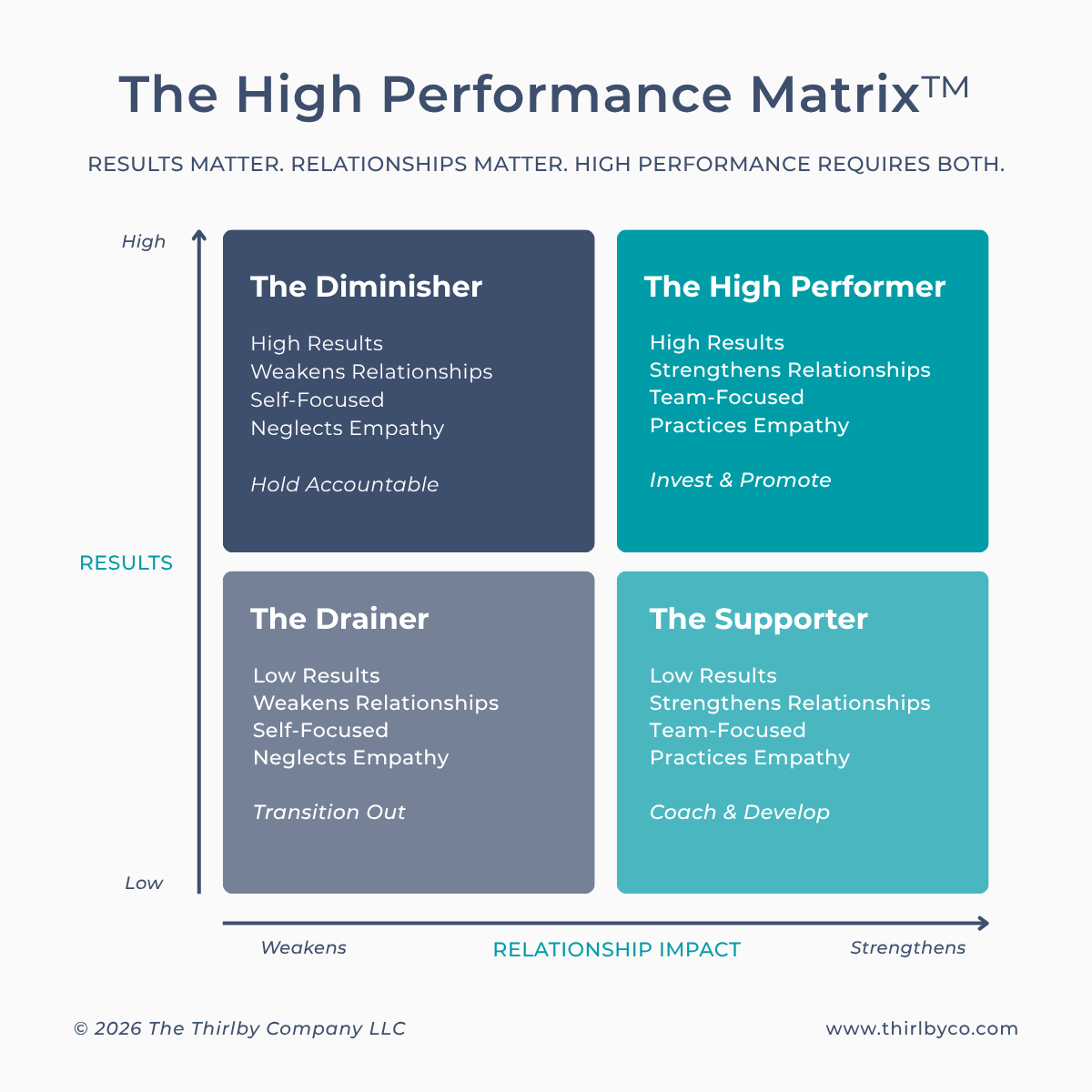
The High Performance Matrix™ is a simple framework for looking at employee performance through two dimensions: Results and Relationship Impact.
When you look at both, four patterns emerge:
The Diminisher
The Diminisher produces strong results but weakens relationships.
Their work may look impressive on paper, but their impact on the people around them tells another story. They may create stress for others, neglect empathy, or prioritize their own success over the success of the team.
Strong results shouldn't give someone permission to damage relationships. These employees need clear feedback and accountability for their relational impact — not another promotion that reinforces the very behavior that needs to change.
The Supporter
The Supporter strengthens relationships but produces lower or inconsistent results.
They're often kind, positive, helpful, and team-focused. They may even be the person everyone loves working with or considers essential to the culture.
Those relational strengths have real value. But relationships alone aren't enough for high performance.
Supporters need coaching and development to strengthen their results. Leaders should also consider whether the role is aligned with their strengths, rather than allowing relational capital to shield a persistent performance gap.
The Drainer
The Drainer struggles on both dimensions.
Their results aren't where they need to be, and their behavior also weakens relationships. Over time, that combination can drain significant energy from a team and make it harder for other people to do their best work.
Yet these employees sometimes remain in organizations because of longstanding relationships with influential leaders, valuable business connections, or a culture that avoids difficult conversations.
When meaningful support, feedback, and accountability aren't creating change, leaders have to be willing to recognize what the pattern is telling them and consider whether it's time to help that person transition out.
The High Performer
The High Performer delivers excellent results and strengthens the people around them.
They build trust. Practice empathy. Share credit. Stay team-focused. And their contribution extends beyond their individual output because they help create the conditions for other people to succeed.
These are the people we should be investing in, retaining, recognizing, and developing into future leaders.
A Few Considerations
The quadrants in The High Performance Matrix™ describe patterns of behavior, not permanent identities.
Experience, training, feedback, organizational culture, and what someone is navigating personally can all influence how they show up at work. People can and will move between quadrants.
But recognizing that people can change doesn't mean ignoring the patterns that you observe. If someone has been repeating the same patterns over a period of time, despite consistent feedback and ample opportunities for professional development, managers must have clear and kind conversations to address the challenges at hand.
Managers must be honest about what — and who — they are rewarding, tolerating, and recognizing.
When someone delivers extraordinary results while repeatedly damaging trust, but gets promoted anyway, people notice.
When someone is well-liked but repeatedly falls short of expectations without accountability, while others are held to higher standards, people notice.
And when the people who consistently deliver excellent work and make their teams stronger are recognized and given opportunities to lead?
People notice that, too.
All of these decisions send a message about culture, values, and what success actually looks like inside an organization.
Results matter. Relationships matter. High performance requires both.
. . .
Ready to Redefine High Performance on Your Team?
Building a high-performing team requires more than setting goals and measuring results. It means developing leaders who know how to strengthen relationships, build trust, and hold people accountable.
Through engaging keynotes and interactive training, The Thirlby Company helps organizations develop confident, human-centered leaders who build healthy teams and drive meaningful results.
Let's explore how we can bring this approach to your organization.