Results matter. Relationships matter. High performance requires both.
Too many organizations either reward employees who weaken culture, or tolerate employees who slow down team performance.
At The Thirlby Co, we believe more businesses need to redefine what high performance actually means. The most effective leaders don't manage their employees the same way. They recognize patterns, tailor their approach, and help people grow toward high performance.
The High Performance Matrix™ helps leaders evaluate performance through two dimensions: Results and Relationship Impact.
The four quadrants aren’t labels — they’re patterns of behavior. We all move between them throughout our careers, but over time, some people may operate in one space more consistently than others.
Scroll down to learn more about about the four quadrants and how to use this tool.
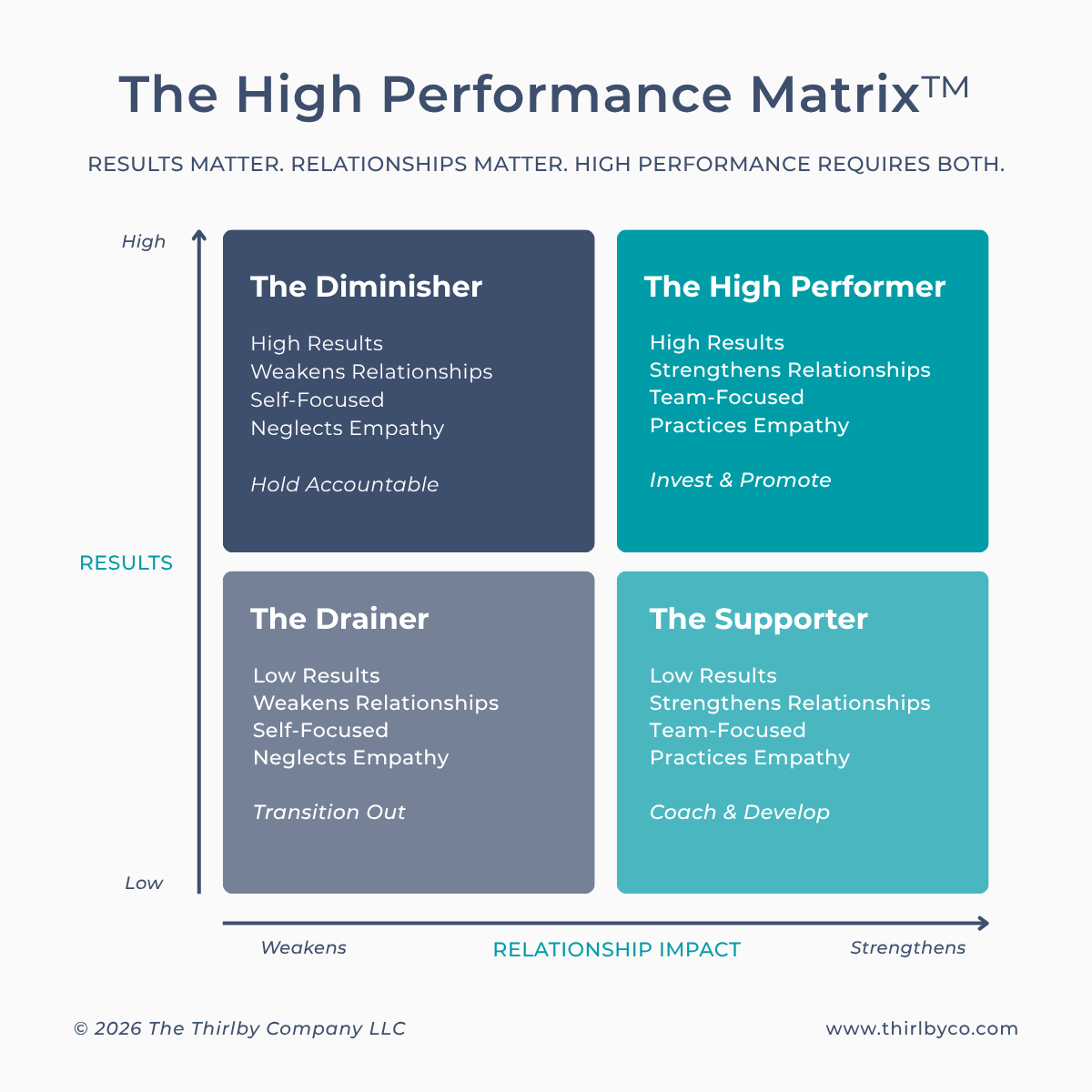
AN OVERVIEW OF THE FOUR TYPES
⚠️ The Diminisher
This employee has high results but weakens relationships. They're often hard to work alongside, even when their output looks impressive on paper. Managers should hold this person accountable for their relational impact, and avoid any promotions until their relationships improve.
🤝 The Supporter
This employee has positive relationships but lower results. They're kind, positive, and team-focused. But in some cases, this person can slow down the team. Managers should coach and develop this person to strengthen their results, and consider whether or not they are in a role that aligns with their strengths.
🪫 The Drainer
This employee struggles to produce results while also weakening relationships. They drain team energy, resist accountability, and make it harder for others to do their best work. Managers should recognize when both results and relationships aren't improving and help them transition out.
🌟 The High Performer
This employee delivers excellent results while strengthening the people around them. They build trust, practice empathy, share credit, and raise the performance of the entire team. Managers should invest in this person, retain them, and develop them into future leaders.
HOW TO USE THIS TOOL
The most effective leaders don't manage their employees the same way. They recognize patterns, tailor their approach, and help people grow toward high performance. So don't just read the quadrants — use them strategically.
1 - Go person by person, not team-wide.
Think through each individual you lead. Where do they spend most of their time?
2 - Name the pattern, not the person.
These are behaviors, not identities. Someone in the Diminisher quadrant today isn't destined to stay there forever. And if someone is in the High-Performance zone, remember they are still human and will have off days.
3 - Consider what each person needs.
If someone isn't in the High Performance zone, consider what support, coaching, or accountability would actually move them there — not just what would make your job easier.
4 - Don't neglect your High Performers.
It's easy to spend all your energy on the people who need improvement. Make sure the people already building trust and results know you see it. Give praise often.
5 - Revisit this quarterly.
People move between quadrants over time. This isn't a one-time label — it's a lens you come back to. However, be honest when patterns aren’t changing. If someone has had real, hands-on support and still isn’t shifting quadrants, that's information too. Growth takes time, but staying stuck despite genuine investment is worth naming, even when it's uncomfortable.
Want to learn more about how to bring this tool to your team? Start a conversation today.